The Idea-to-MP4 Pipeline: AI Video Studios in 2026
End-to-end AI studios now take you from a text prompt to a finished MP4. Here's how the idea-to-MP4 pipeline is reshaping filmmaking for independent creators.
July 14, 2026
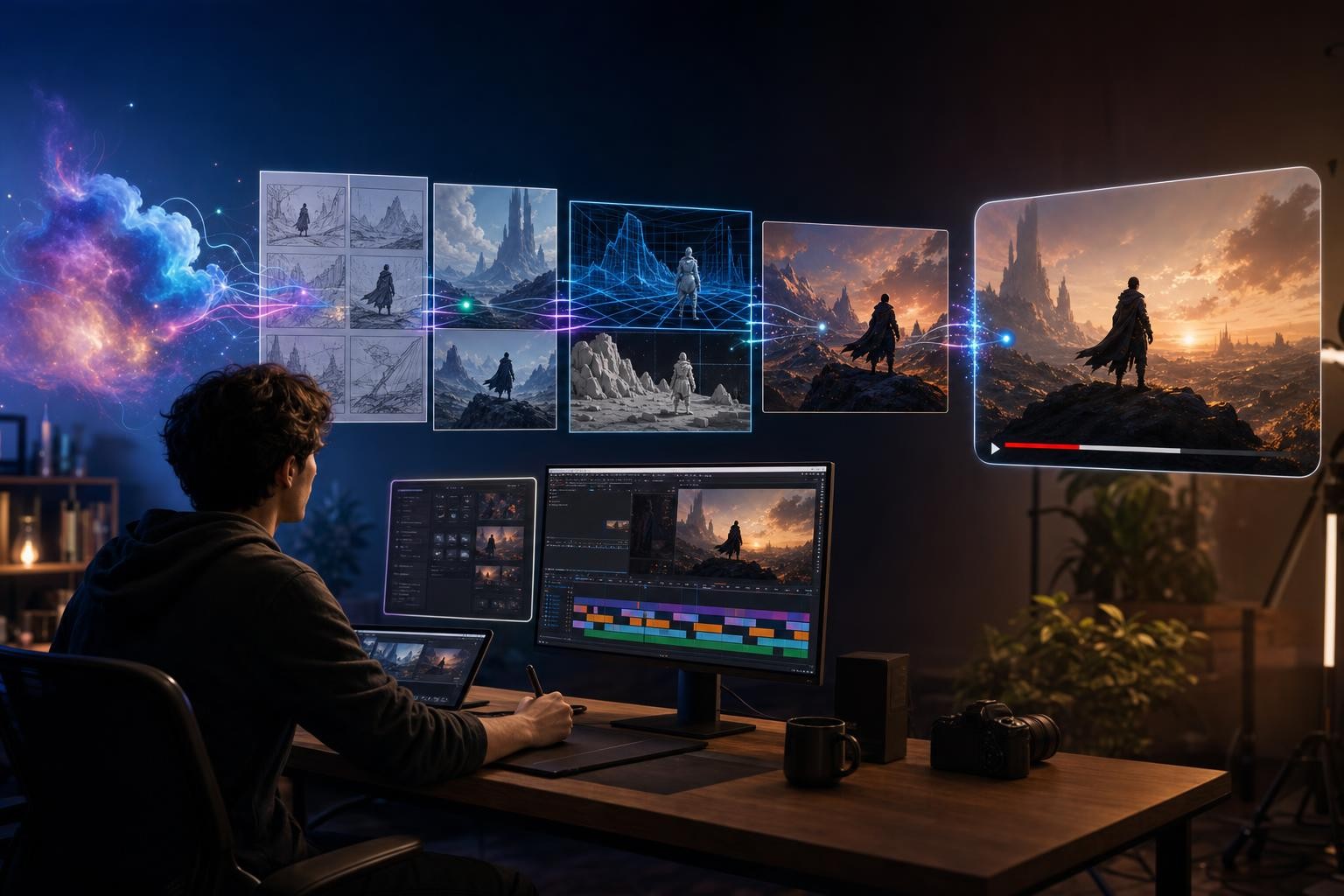
For most of film history, turning an idea into a watchable video meant stitching together a dozen disconnected tools, skills, and hand-offs. In 2026, that gap is closing fast. A new class of AI video studio can take a single sentence and return a finished MP4 — script, visuals, edit, and sound included. This is the 'idea-to-MP4' pipeline, and it's quietly rewriting who gets to make films.
Why the Old Filmmaking Workflow Was Broken
Traditional video production is a relay race with too many batons. You write in one app, storyboard in another, shoot or source footage separately, edit in a heavyweight timeline tool, then bounce audio into yet another program for narration and mixing. Every hand-off introduces friction: exporting, reformatting, waiting, and re-learning interfaces.
For independent creators without a team, this fragmentation is the real bottleneck. The creativity is there — the problem is that 80% of the effort goes into logistics, not storytelling. A great idea dies not because it was bad, but because assembling it demanded five specialties and a hundred hours.
What 'Idea-to-MP4' Actually Means
The idea-to-MP4 pipeline collapses that relay race into a single continuous flow. Instead of moving assets between tools, you describe what you want and an end-to-end AI studio handles each production stage in sequence, keeping everything consistent along the way.
- Concept and script: A text prompt expands into a structured narrative with scenes, beats, and dialogue.
- Storyboard and visuals: Each scene is generated as a clip, with characters and settings that carry across shots.
- Continuity: The same character looks and sounds the same in scene one and scene twelve.
- Audio: Narration and multi-speaker dialogue are voiced and timed to the visuals automatically.
- Assembly and export: Clips are sequenced into a coherent story and rendered as a shareable MP4.
The key word is continuous. You aren't exporting a storyboard to import into an editor. The pipeline treats the whole film as one living project, so a change to the script can ripple through the visuals and audio without a manual rebuild.
The Hard Problem: Consistency Across Clips
Early AI video tools could produce one striking clip at a time, but they fell apart over a full story. The protagonist's face shifted between shots. Lighting jumped. A character introduced as calm suddenly sounded like a different person. That inconsistency is what separated a fun demo from an actual film.
The 2026 generation of AI video studios solves this by treating characters, scenes, and voices as persistent entities rather than one-off generations. This is where tools like Yoh stand out: from a single text prompt it builds a complete multi-clip story with consistent characters, scene continuity, narration, and multi-speaker dialogue — the exact elements that used to break down over longer runtimes.
The breakthrough isn't generating a beautiful shot. It's generating the hundredth shot that still belongs in the same film.
What This Unlocks for Independent Creators
When production friction drops toward zero, the creative calculus changes. You can test an idea in an afternoon instead of committing a month to it. You can iterate on tone, pacing, and dialogue the way a writer edits prose. And you can produce at a volume that was previously impossible for a solo creator.
- Episodic storytelling: Build a recurring cast and release a series without re-establishing your world each time.
- Faster experimentation: Prototype multiple versions of a concept before choosing a direction.
- Multilingual reach: Produce for audiences in English, Traditional Chinese, Korean, and Japanese without separate shoots.
- Direct monetization: Publish finished work to a link-in-bio page and sell access to your audience.
- Programmatic scale: Use a REST API to generate videos automatically inside your own apps or workflows.
How to Get Started With the Pipeline
The temptation with any powerful tool is to skip the fundamentals. Don't. The pipeline handles execution, but you still own the story. Treat your prompt like a creative brief, not a magic spell.
- Start with a clear premise: who is the character, what do they want, and what's at stake.
- Describe tone and pacing explicitly — 'warm and slow' produces a very different film than 'sharp and urgent.'
- Define your characters once so the studio can keep them consistent across every scene.
- Generate a first pass, watch it as an audience member, then refine the weakest scene.
- Assemble episodes into a series so your audience has a reason to return.
The creators who win in this era won't be the ones with the most gear. They'll be the ones with the clearest ideas and the fastest loop between imagining a story and watching it play back.
The Bottom Line
Filmmaking used to reward endurance as much as vision. The idea-to-MP4 pipeline shifts the reward back toward vision. When one prompt can become a consistent, narrated, multi-scene video ready to publish and sell, the barrier isn't production anymore — it's having something worth saying. For independent creators in 2026, that's the most exciting shift in decades.
Try Yoh free →